

Water electrolysis virtual lab.
An electric current can split water into the two gases it is made of. The student passes a current through water with a little acid in it, collects the hydrogen and the oxygen, measures their volumes and tests each gas.
In this virtual chemistry lab the student hangs two carbon electrodes in distilled water, sets the power supply to 6 V and adds a little dilute sulfuric acid so that a current can flow. Hydrogen and oxygen collect in two upturned test tubes, their volumes are read off the scale, and a burning splint tests each gas.
Request a demo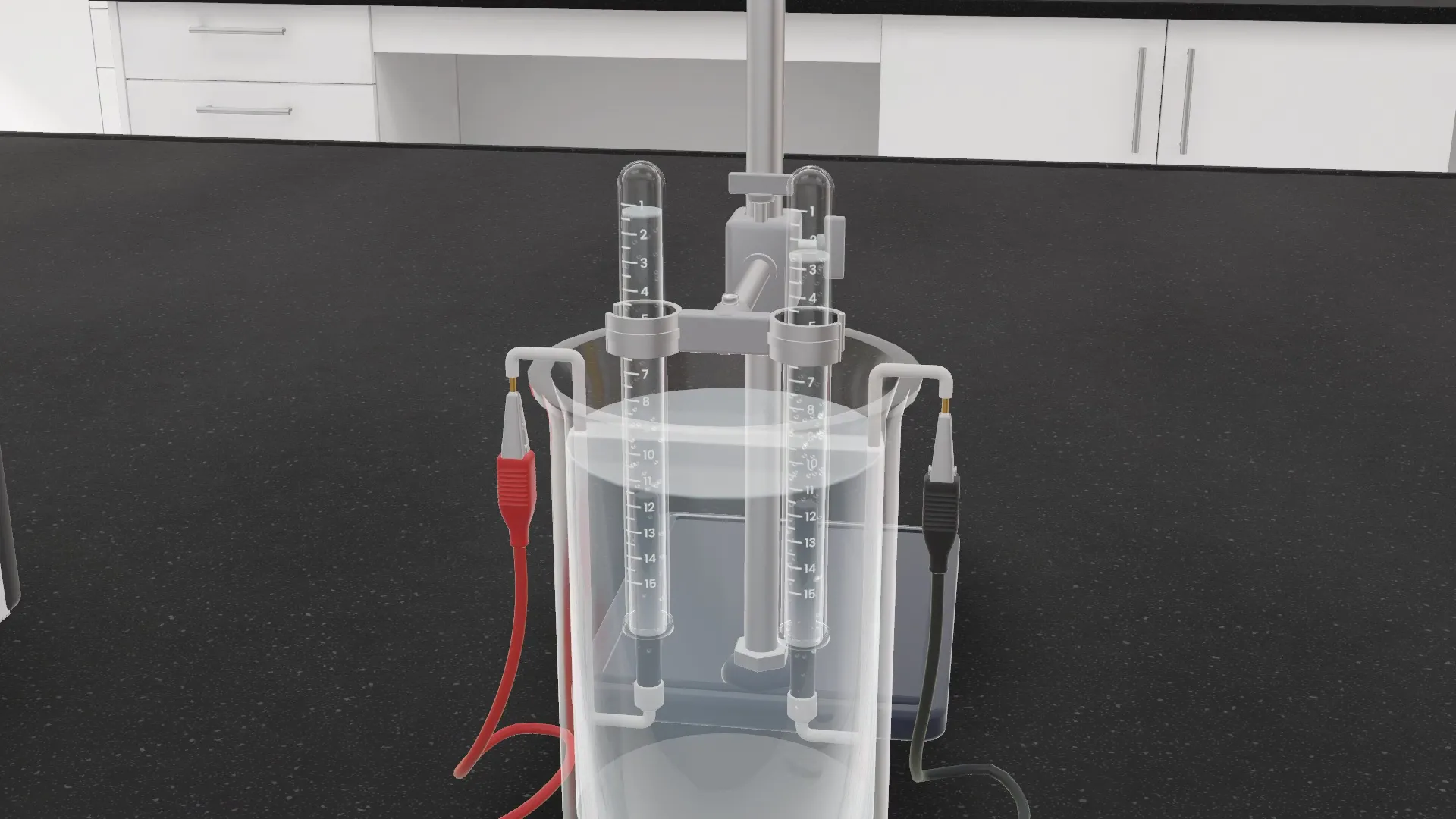
What students learn.
- Split water into hydrogen and oxygen with an electric current, and test each gas.
- Measure the volumes of the two gases and find their ratio.
- See how the amount of gas depends on the current and on the time.
Step by step.
The steps the student follows in the app, with what the lab shows at each one.
- 1
Hang the anode and the cathode on the rim of the beaker of distilled water.
Observation
The red lead joins the anode to the positive side of the supply, and the black lead joins the cathode to the negative side. Both electrodes are carbon, which is inert: it carries the current and is not used up.
- 2
Switch on the power supply and set it to 6 V. Watch the electrodes.
Observation
Nothing happens. Pure water has too few ions to carry a current, so almost none flows and the water is not split.
- 3
Open the bottle of dilute sulfuric acid and add some to the water with the dropper.
Observation
Bubbles form on both electrodes, more of them at the cathode. The acid gives the water ions that carry the current. The acid itself is not used up.
- 4
Switch off. Fill the two test tubes with water and stand them upside down over the electrodes.
Observation
A tube that is full of water has no air in it. The gas that rises from the electrode collects at the top of the tube and pushes the water down, so its volume can be read off the scale.
- 5
Switch on and watch the gases collect.
Observation
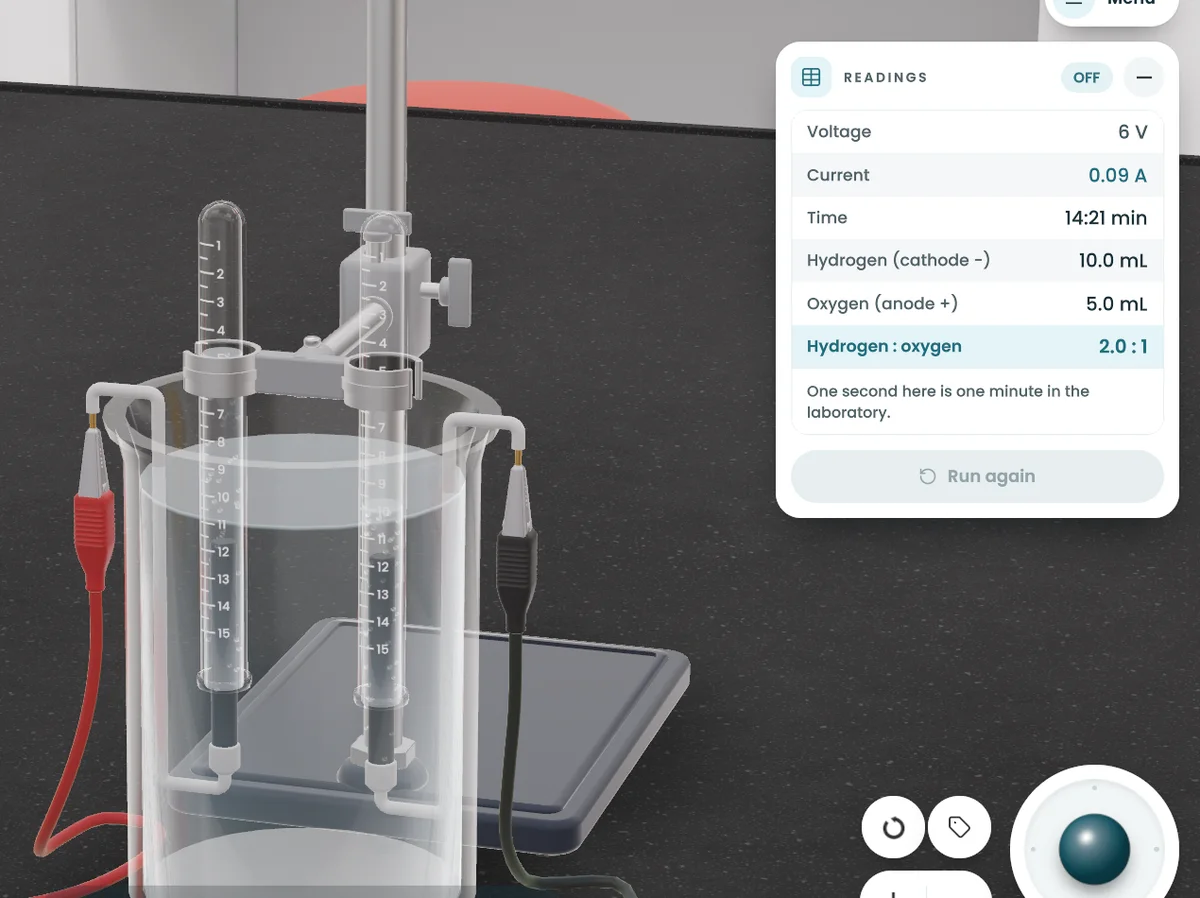
Water is split into the two elements it is made of. There is twice as much hydrogen as oxygen, two volumes to one. A bigger current, or a longer time, gives more gas.
water (liquid) → hydrogen (gas) + oxygen (gas)
2H2O(l) → 2H2(g) + O2(g)
- 6
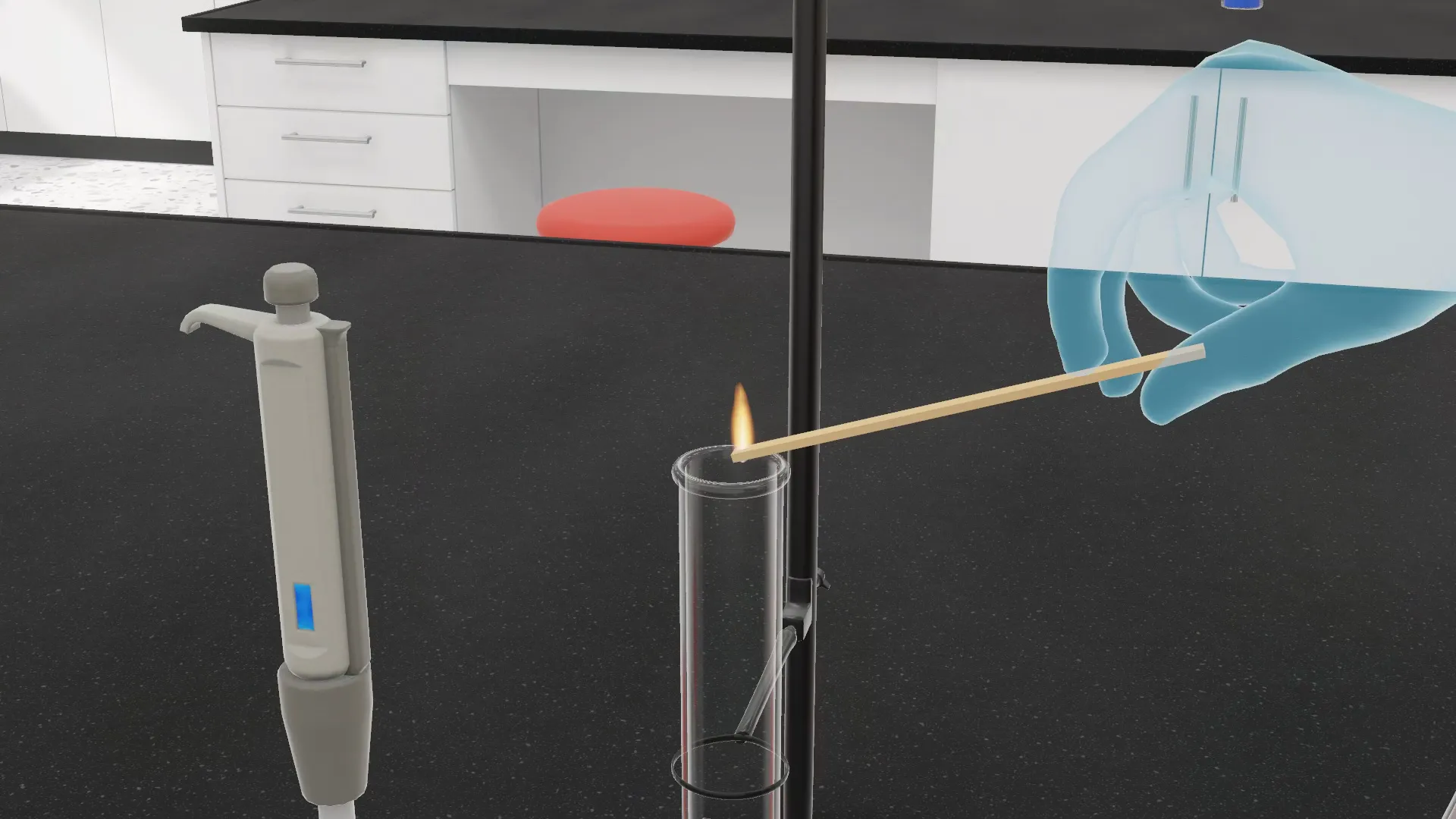
Light the splint at the burner and bring the flame to the mouth of the hydrogen tube.
Observation
The gas burns with a squeaky pop: it is hydrogen. It forms at the cathode, the negative electrode, where hydrogen ions take up electrons. As it burns it joins with oxygen and makes water again.
2H+(aq) + 2e− → H2(g)
- 7
Light the splint again and bring it to the oxygen tube.
Observation
The glowing splint bursts into flame: the gas is oxygen. It forms at the anode, the positive electrode, where water gives up electrons. So water is made of hydrogen and oxygen. In a real laboratory a little less oxygen than half is collected, because some of it dissolves in the water and a little reacts with the carbon of the anode.
2H2O(l) → O2(g) + 4H+(aq) + 4e−
The result
H₂ : O₂ = 2 : 1
Collected over the two electrodes and read off the tubes: 10.0 mL of hydrogen to 5.0 mL of oxygen, as the formula of water, H₂O, says.
Built for the board at the front of the class.
Most classrooms already teach from an interactive screen. Gnosis Labs is made for it first, so the whole class can follow one experiment together. The same labs run on tablets, phones and PCs.
Every word on the screen and every spoken instruction comes in both languages. Arabic reads right to left.
More in the labs.

Request a demo
See it in your school.
Tell us about your school and we will arrange a demo of the labs for you and your teachers.