

Free fall virtual lab.
Some objects fall freely with no force acting on them but gravity. In this experiment the student calculates the acceleration due to gravity using a free-fall apparatus.
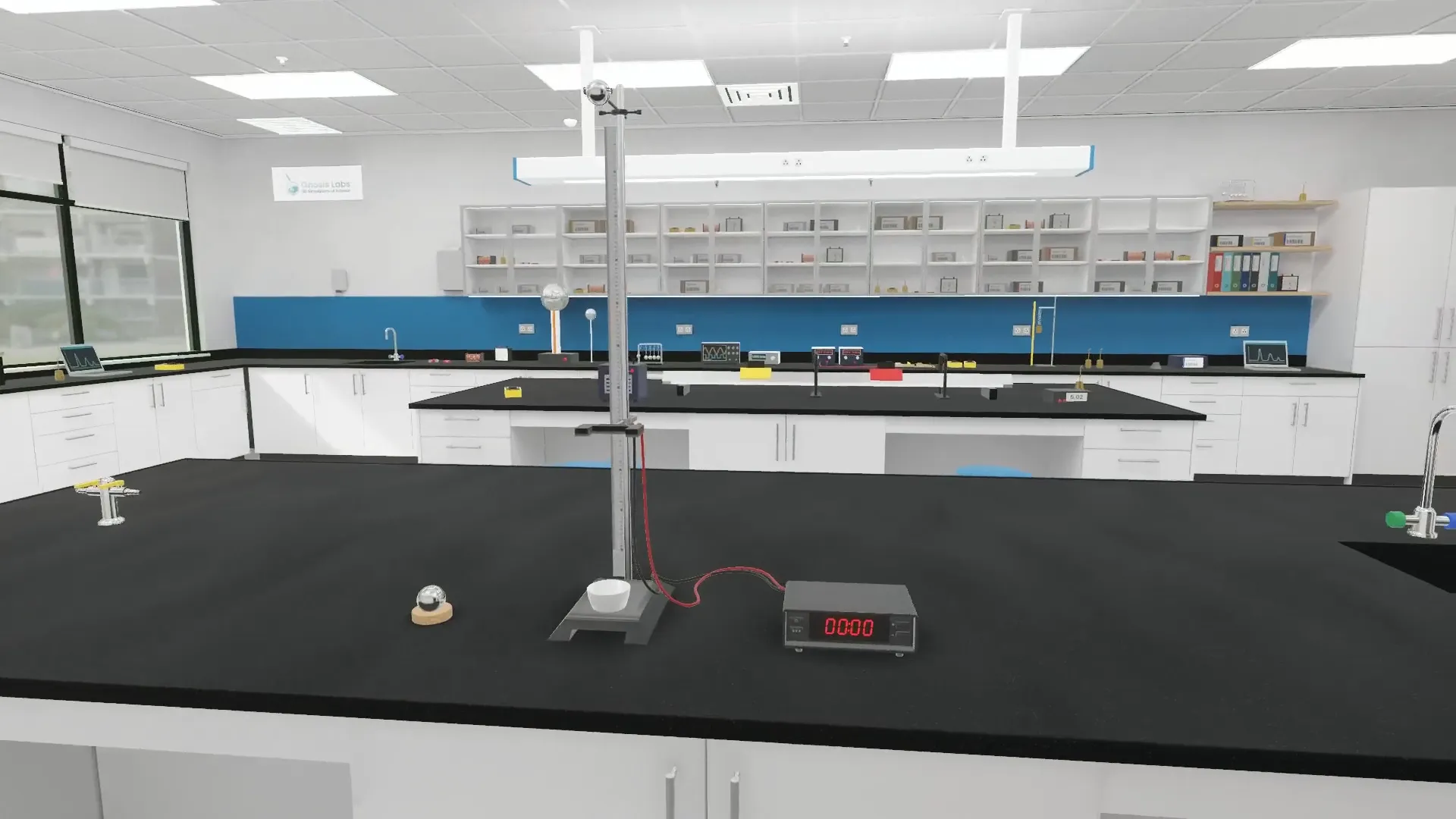
In this virtual physics lab the student slides a gate along a ruler to set the distance, releases a ball and records the distance and the time in a table. After six readings they choose two points on the line: g is twice its slope. A heavier ball then shows that mass does not change the time of the fall.
Request a demo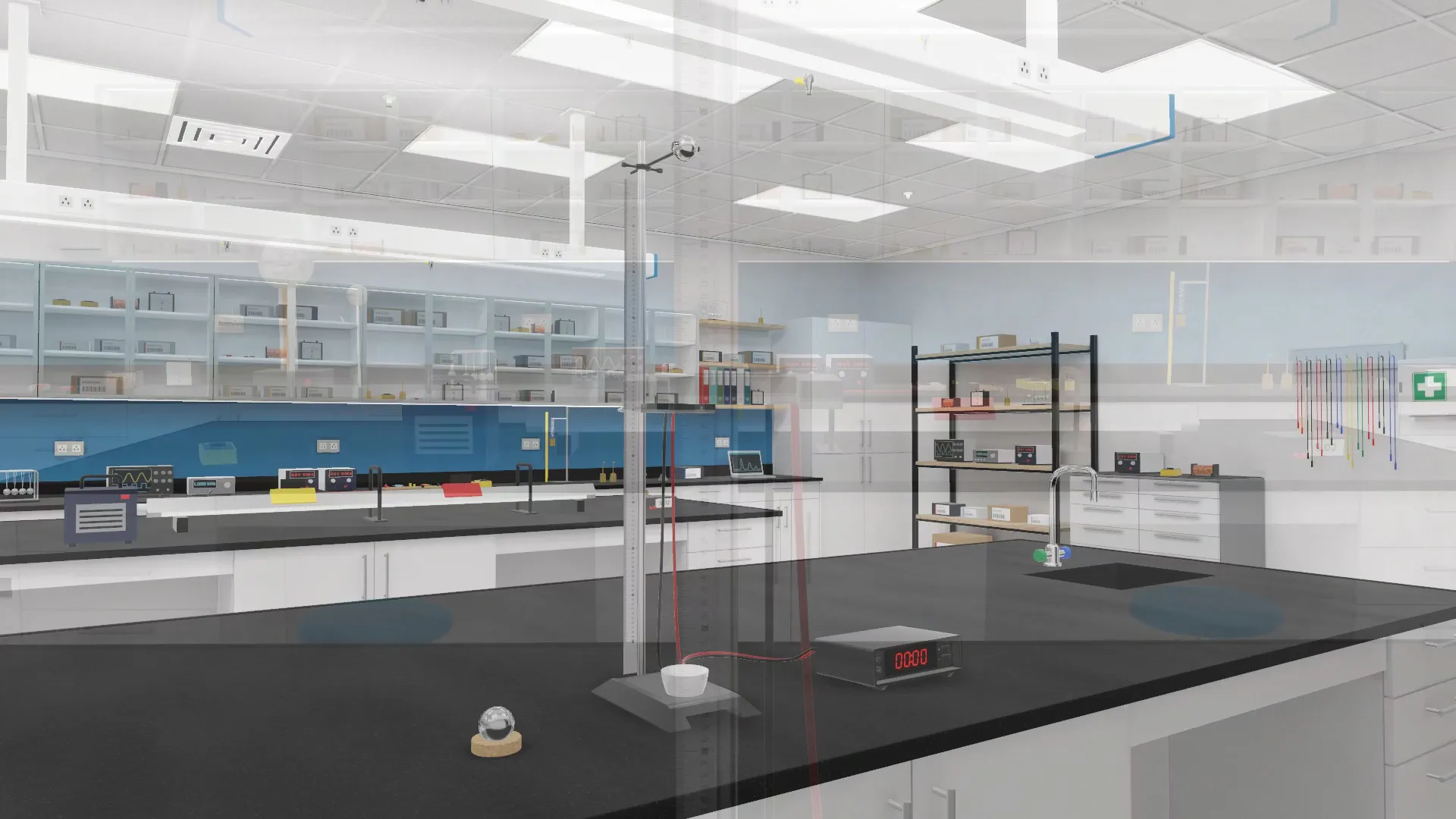
What students learn.
- Calculate the acceleration due to gravity using a free-fall apparatus.
Step by step.
The steps the student follows in the app, with what the lab shows at each one.
- 1
Slide the gate along the ruler to choose the distance the ball will fall.
Observation
The gate is a sensor: the timer stops the moment the ball passes between its arms. The zero of the ruler is level with the bottom of the ball, so the reading beside the gate is how far the ball falls before it is timed.
- 2
Tap the ball to release it, and watch the timer.
Observation
The timer started when the ball was let go and stopped as it passed the gate. Only gravity acts on the ball as it falls: this is free fall. It starts from rest and gets faster all the way down.
- 3
Press Record to write the distance and the time in the table.
Observation
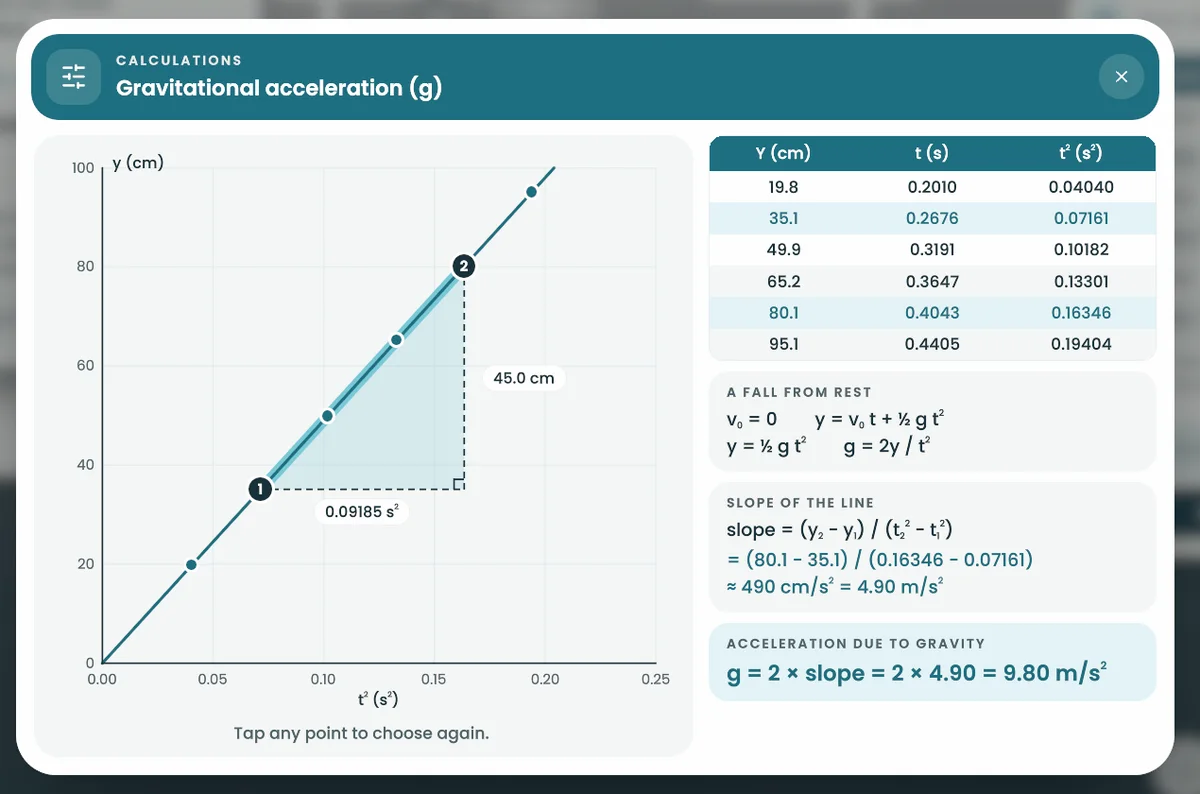
The table also works out the square of the time. For a ball that falls from rest, the distance goes with the square of the time:
y = ½ g t2
- 4
Put the ball back and take five more readings, each at a different distance.
Observation
A longer fall takes longer, but not in proportion: four times the distance takes only twice the time. The further the ball has fallen, the faster it is moving.
- 5
Open Calculations and choose two points on the line to find g.
Observation
The points lie on a straight line through the origin. Its slope is half of g, so g is twice the slope: the acceleration due to gravity, about 9.8 metres per second squared.
g = 2 × slope ≈ 9.8 m/s2
- 6
Load the heavier ball and release it from a distance you have already recorded.
Observation
The heavier ball took the same time. In free fall every object speeds up at the same rate, whatever its mass.
The result
g = 9.80 m/s²
Worked out by the student from the slope of the line through their own readings. The accepted value is 9.81 m/s².
Built for the board at the front of the class.
Most classrooms already teach from an interactive screen. Gnosis Labs is made for it first, so the whole class can follow one experiment together. The same labs run on tablets, phones and PCs.
Every word on the screen and every spoken instruction comes in both languages. Arabic reads right to left.
More in the labs.
Request a demo
See it in your school.
Tell us about your school and we will arrange a demo of the labs for you and your teachers.