

Metals and hydrochloric acid virtual lab.
Students learn how metals react with hydrochloric acid, and identify the metal used by tracking the speed of the reaction and the amount of hydrogen gas released.
In this virtual chemistry lab the student puts zinc in a test tube, adds 10 mL of 3 M hydrochloric acid and tests the gas with a burning splint: a squeaky pop shows it is hydrogen. In concentrated acid the reaction is faster, the hydrogen fills a balloon, and a flame sets it off in a ball of fire.
Request a demo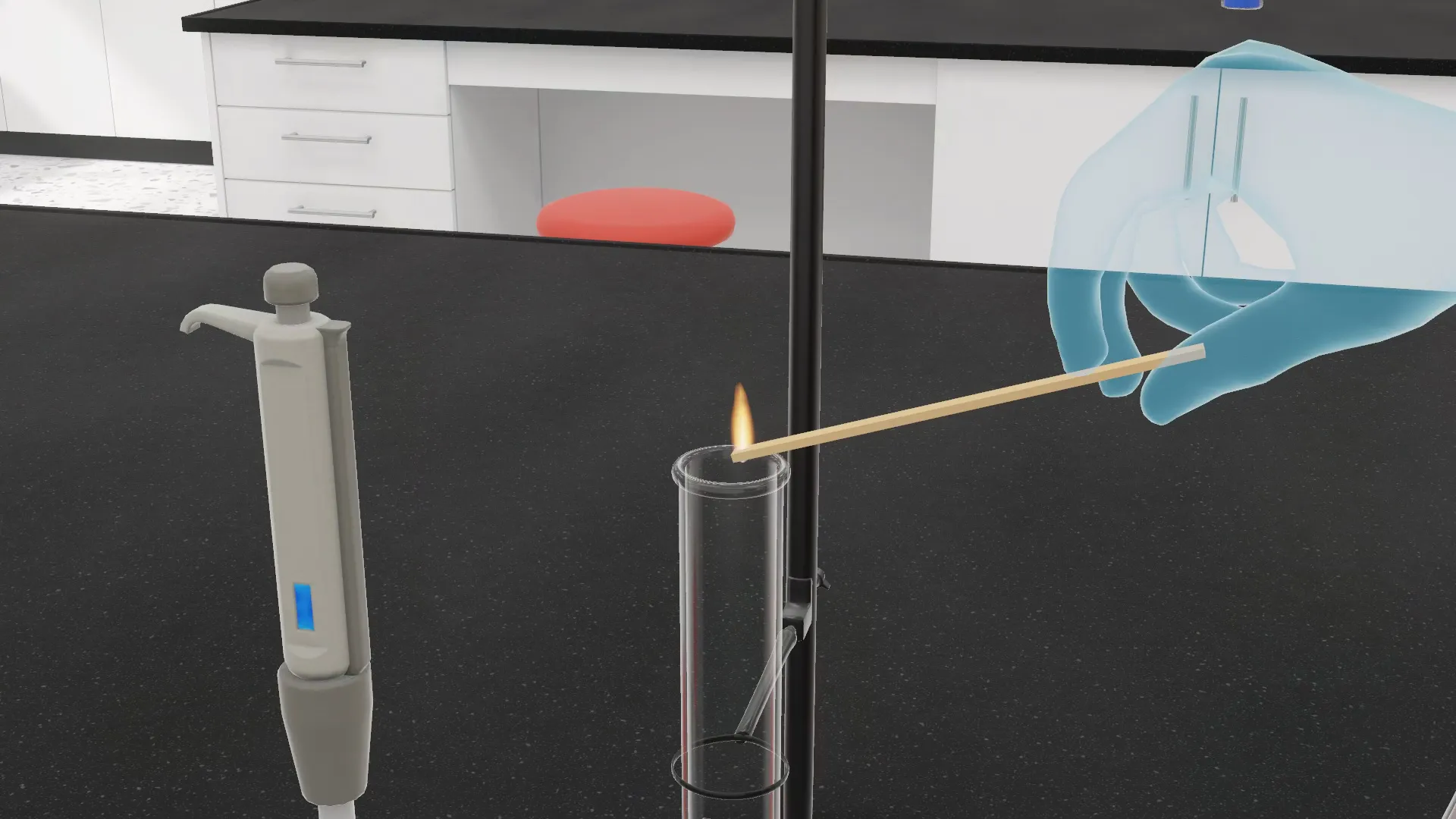
What students learn.
- Study how metals react with hydrochloric acid.
- Prepare hydrogen gas.
- Study the properties of hydrogen gas.
Step by step.
The steps the student follows in the app, with what the lab shows at each one.
- 1
Place two pieces of zinc in the test tube.
Observation
Zinc is a metal: grey and solid. By itself in the tube nothing happens to it. It needs something to react with.
- 2
Measure 10 mL of 3 M hydrochloric acid and add it to the test tube.
Observation
Bubbles form on the zinc as soon as the acid reaches it, and rise through the liquid. They are a gas: zinc reacts with hydrochloric acid and gives off hydrogen. The zinc gets smaller as it is used up.
- 3
Light a wooden splint and bring the flame to the mouth of the tube.
Observation
Hydrogen gas is given off when zinc reacts with hydrochloric acid, as this word equation says:
zinc (solid) + hydrochloric acid (solution) → zinc chloride (solution) + hydrogen (gas)
Zn(s) + 2HCl(aq) → ZnCl2(aq) + H2(g)
- 4
Place two pieces of zinc in the conical flask filled with concentrated hydrochloric acid.
Observation
In the flask the zinc fizzes far harder than it did in the tube. The acid here is concentrated: the stronger the acid, the faster the reaction, and the more hydrogen is given off each second.
- 5
Fit the balloon over the mouth of the conical flask.
Observation
The balloon fills by itself. With its mouth covered the flask lets no gas out, so the hydrogen coming off the zinc collects in the balloon and stretches it.
- 6
Light a wooden splint at the burner and bring the flame to the balloon filled with hydrogen gas.
Observation
The balloon goes off in a ball of fire. Hydrogen burns very fast when a flame reaches it: it joins with the oxygen of the air and makes water.
hydrogen (gas) + oxygen (gas) → water (vapour)
2H2(g) + O2(g) → 2H2O(g)
Built for the board at the front of the class.
Most classrooms already teach from an interactive screen. Gnosis Labs is made for it first, so the whole class can follow one experiment together. The same labs run on tablets, phones and PCs.
Every word on the screen and every spoken instruction comes in both languages. Arabic reads right to left.
More in the labs.
Request a demo
See it in your school.
Tell us about your school and we will arrange a demo of the labs for you and your teachers.